
Congress special convention: Leadership dispute could spark legal battles
Failure to resolve the standoff could impact the party’s strategy for the March 5 elections

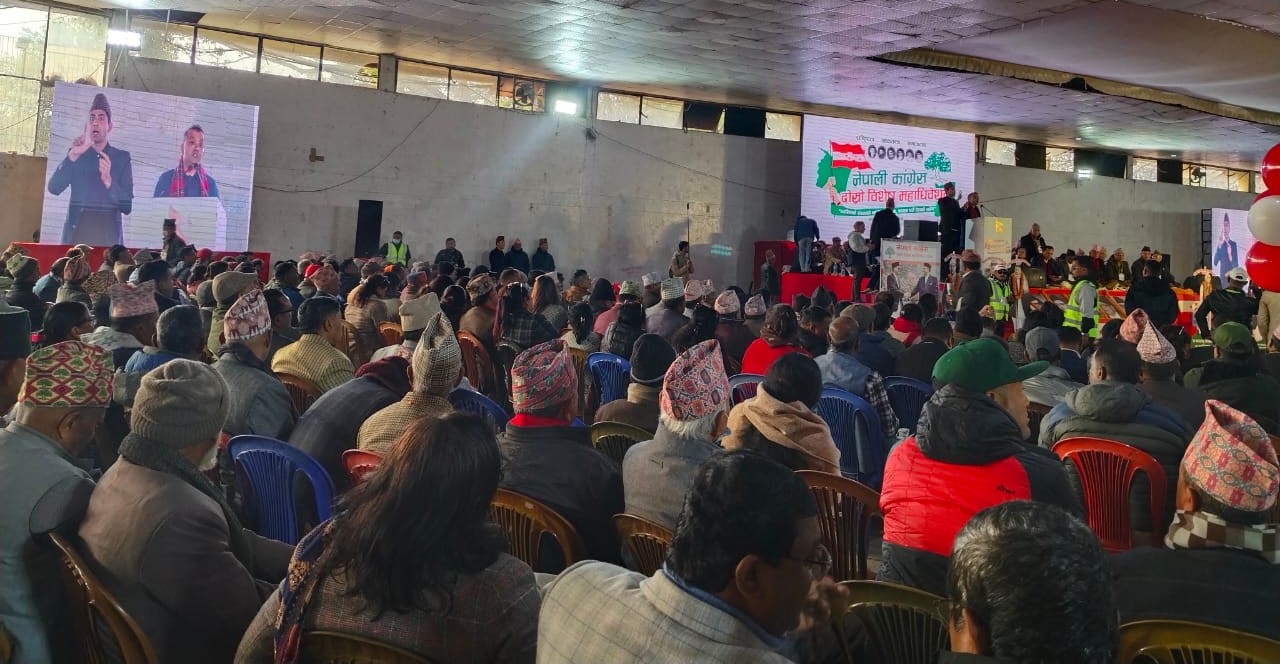
Kathmandu: Amid intense resistance from the Sher Bahadur Deuba-led faction, the dissident group of the Nepali Congress, spearheaded by General Secretaries Gagan Thapa and Bishwo Prakash Sharma, successfully held a special general convention — only the second in the party’s 79-year history. More than half of the party’s convention representatives showed up at Bhrikuti Mandap, the venue, throwing their weight behind the proposed leadership change, a move viewed as a significant political coup.
During the closed session on Monday, the delegates proposed scrapping the central working committee elected by the 14th general convention in December 2021, setting in motion a potential end to Deuba’s control over the party. The proposal, however, must be formally endorsed, and with one faction refusing to accept the decisions, enforcement could prove difficult.
The Election Commission (EC) now plays a pivotal role. The dissident faction, claiming to represent the “real” Nepali Congress, is expected to submit the convention’s decisions to the EC. If the EC refuses recognition, the faction could approach the Supreme Court. If it accepts, the Deuba faction may challenge the move legally. A swift resolution is unlikely, given the bureaucratic and judicial procedures involved.
The standoff may have electoral consequences. Nominations for candidates under the direct election system for the upcoming House of Representatives election on March 5 are due on January 20. The failure to settle the leadership dispute could profoundly impact candidate selection and campaign strategy, with the party potentially contesting elections as a divided house, even if it does not formally split into two.
The Thapa-Sharma group has also vowed to end alliance politics, meaning the Nepali Congress will contest the elections independently — a sharp departure from previous elections when the party formed alliances to secure a comfortable win. Analysts warn that if Congress remains divided at the polls, it could weaken its position despite being the single largest party in the last election.
The current crisis has its roots in the Gen-Z protests of September 8–9, after which General Secretary Thapa called for leadership and policy changes. With no regular general convention scheduled, signatures were collected in October demanding a special convention. By October 15, roughly 54 percent of representatives submitted a petition calling for a convention to review policy and leadership.
The party statute mandates that a special convention be held within three months if at least 40 percent of delegates demand it. Yet, during the Central Working Committee meeting beginning October 14 and lasting over a month, the issue was ignored, and a schedule for the regular general convention was proposed for mid-January.
After being attacked by demonstrators at his residence on September 9, Deuba appointed Vice President Purna Bahadur Khadka as acting president and left for Singapore for medical treatment. Many within the party read this as his retreat from active politics. But upon his return, he reasserted authority and dismissed calls for a special convention, prompting the general secretaries to take a decisive step. The special convention was the outcome.
Deuba still appears firm and defiant. He and his faction leaders have consistently called the special convention illegitimate.
The special convention, despite its success with the support of more than 50 percent of delegates, brings to the fore a complex legal scenario. While the pro-special convention group claims legitimacy under party statutes, Deuba’s group may argue procedural violations, as it has consistently maintained that a special convention lacked justification. Furthermore, it has questioned the legality of a convention conducted without the central working committee’s endorsement.
The EC’s decision to recognise or reject the special convention’s decisions will ultimately lead either faction to approach the Supreme Court. This, in turn, will impact the party’s strategy for the March elections.